
Television Mounts Anchored to the Wall That Holds
TV mounting installation in Burlington for homes where wall construction determines the bracket approach and cable routing options
Burlington-area homes span a wide range of construction eras and wall types, and the wall material behind the drywall is the first factor that determines how a television mount is anchored and whether cables can be routed inside the wall. Integrity Home Technologies mounts televisions across Northern Kentucky with bracket anchoring into wall studs or rated hardware matched to the specific wall construction found on the day of the job. Owner and installer Stephen Ratcliffe draws on more than 20 years of low voltage work—the same in-wall cable routing used for audio and networking—so cable concealment is part of the mounting job rather than an afterthought.
Wall construction is assessed and stud locations are marked before any drilling begins. On pre-wired newer Boone County builds, power and signal cables are typically routed through existing pathways behind the mount, while older construction with plaster and lath requires a different approach to anchoring and often limits in-wall cable routing to specific wall cavities. Viewing height is set against the actual seating position in the room rather than a standard measurement, because the correct height varies depending on whether the room has a low sectional or a dining-height setup.
To confirm wall construction and plan cable routing before any drilling starts, book a TV mounting visit with Integrity Home Technologies.
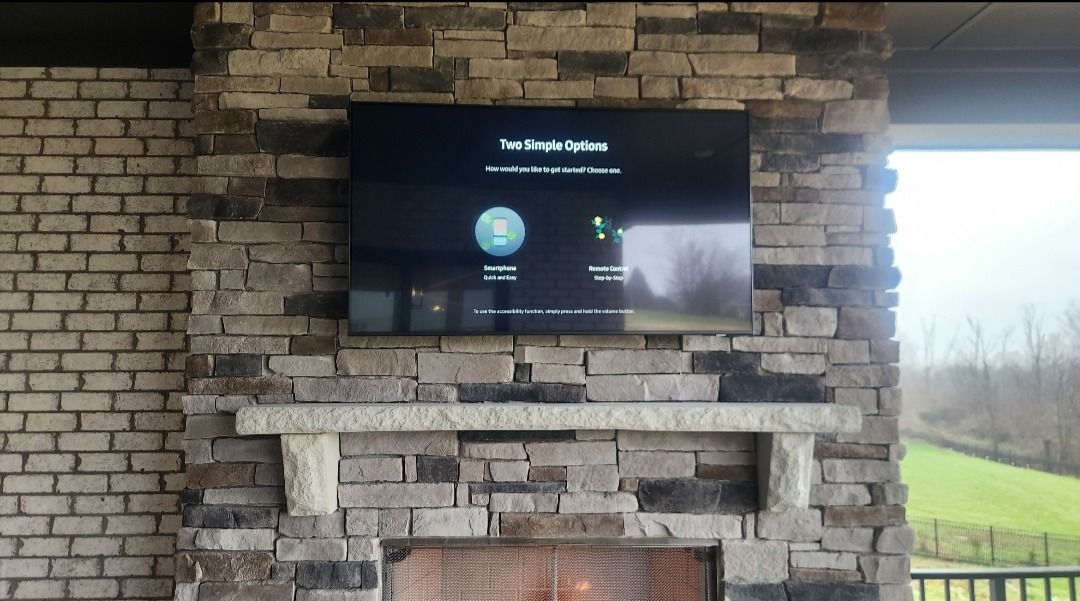
The Difference Between a Secured Mount and One That Just Holds for Now
A bracket anchored into a stud distributes the television's weight across the framing of the wall rather than relying on drywall anchors, which can creep over time under a heavy panel. During every TV mounting job, Integrity Home Technologies locates studs with a calibrated finder and confirms the bracket spans two stud bays for televisions above a certain weight class, rather than centering a single-stud mount on the preferred wall location and adjusting from there. That sequencing—structure first, placement second—prevents the bracket from being positioned where it looks right but where the anchoring is inadequate.
After the installation, what you notice is a level screen at the right height for the room with cables that are not trailing down the face of the wall. Where in-wall routing is possible given the construction, power and signal cables disappear behind the mount; where it is not possible, cables are managed with surface-mounted raceway installed flush rather than left loose. The mount itself is stable under the weight of the panel with no tilt or shift when the screen is adjusted.
Tilt and articulating arm mounts require additional consideration during planning because they shift the center of gravity when extended, placing different loads on the anchor points than a fixed flat mount of the same weight class. The bracket selection accounts for the arm type and the panel weight together, not the panel weight alone, which affects which stud configuration and anchor hardware are appropriate for that specific installation.
Answers About How TV Mounting Works
The questions below cover the practical decisions involved in TV mounting—how wall construction affects the approach, what cable routing involves, and what the finished mount should look like.
How does wall construction affect the mounting approach in Burlington-area homes?
Older plaster and lath walls require masonry or toggle anchors rated for the panel weight because studs are harder to locate and the surface layer cannot be drilled through with a standard bit the same way drywall can, while newer drywall construction allows direct stud anchoring using the bracket's standard hardware.
What is checked before the bracket position is marked?
Stud locations are confirmed with a calibrated finder and the bracket is positioned to span two stud bays where the panel weight requires it, with the final position adjusted to center the screen on the intended wall area without compromising the anchor points.
How is viewing height determined for a specific room?
Height is set based on the seated eye level of the primary viewing position in the room, which differs depending on seating height and distance from the wall—a measurement taken in the room rather than applied from a standard chart.
What happens with cables when in-wall routing is not possible?
When wall construction prevents running cables through the cavity behind the mount, surface-mounted raceway is installed flush to the wall and painted or finished to reduce visual presence rather than leaving cables loose against the wall face.
Why does the type of mount arm affect anchor hardware selection?
An articulating arm shifts the load away from the wall when extended, creating a lever effect on the anchor points that a fixed flat mount does not produce, so the anchor hardware and stud configuration are selected for the extended-arm load rather than the resting position weight.
Integrity Home Technologies also mounts televisions in Cincinnati, Union, Lebanon, Newport, and Mason. To have wall construction assessed and a bracket anchored correctly for your specific room and panel, call (513) 375-2342.