
Outdoor Sound Planned Around Your Actual Yard
Pool audio installation in Burlington for backyards where a single speaker cannot cover the deck, patio, and lawn together
Many Burlington and Union properties sit on long, sloped lots where the pool deck, a raised patio, and a lower lawn occupy different elevations and distances from any single speaker location. Integrity Home Technologies installs pool audio systems in Burlington designed around that kind of yard geometry rather than a copied template. Speaker count, placement angles, and wiring paths are mapped during a yard walkthrough before any hardware is ordered or conduit is run.
Every installation begins with a walkthrough to identify where sound needs to cover, where it does not—speakers angled toward the water surface create acoustic problems and are positioned to avoid it—and where wiring can run without crossing existing underground structures or hardscape. Wiring travels through weatherproof conduit, speakers are mounted at angles that distribute sound evenly across the deck and adjacent zones, and the system connects to a control point the homeowner operates from a phone or an indoor receiver. Before leaving, the owner walks every client through how the system works.
Schedule a yard walkthrough with Integrity Home Technologies to map speaker zones and wiring paths specific to your property layout.
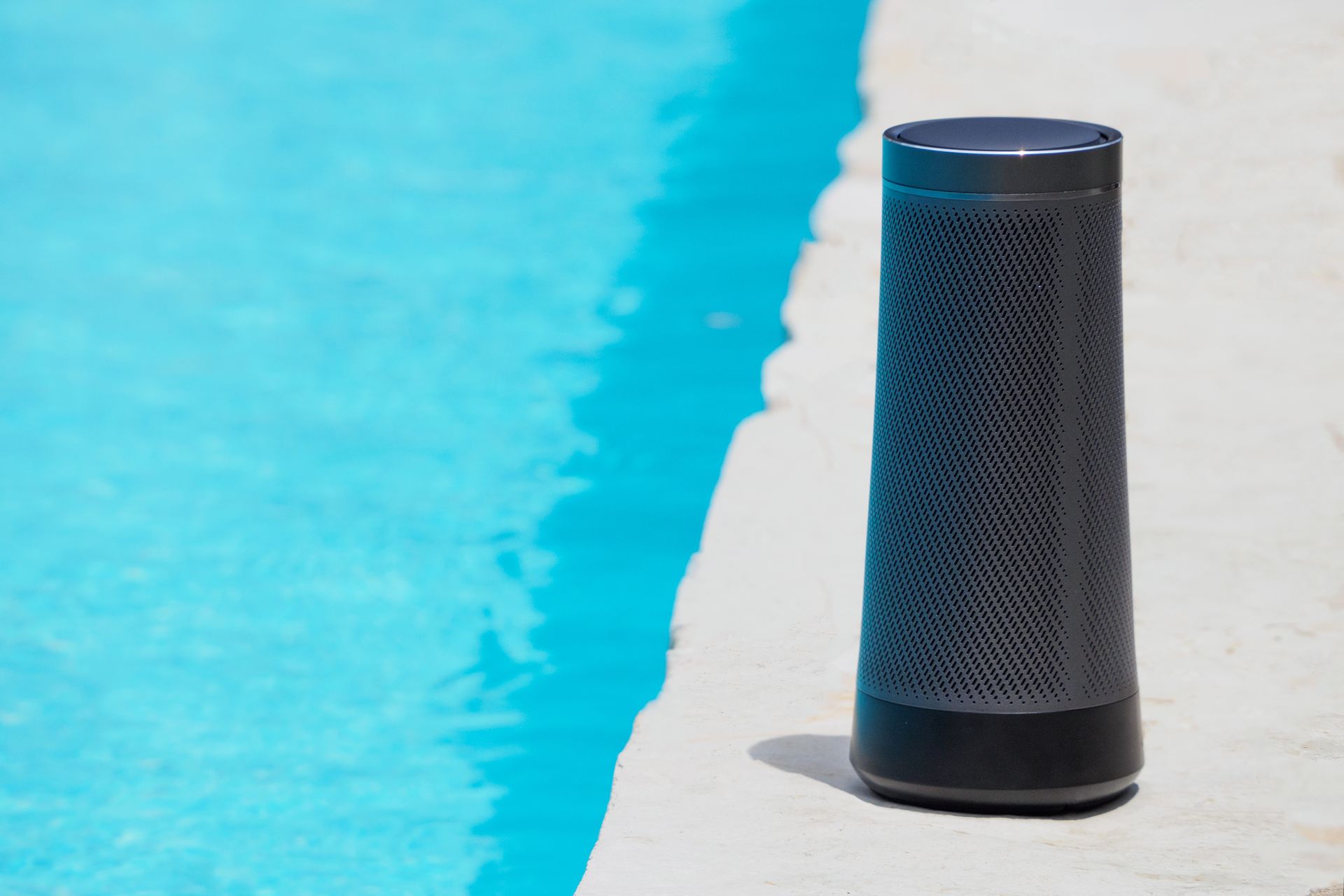
Why Speaker Placement Drives the Whole Installation
Outdoor audio differs from interior work in one critical way: there are no walls to reflect sound, so coverage depends entirely on the number, placement, and aim of individual speakers. A speaker mounted too high covers a wider area but loses low-frequency presence at ground level where people are seated. One mounted too low covers less ground and gets blocked by furniture, planters, or grade changes. Integrity Home Technologies plans speaker height and aim angles during the walkthrough, using the actual dimensions of the deck and lawn zones rather than generalizing from a standard layout.
Once the system is active and tested, what the homeowner notices is consistent volume across the deck and patio without a loud spot directly under any speaker or a dead zone at the edge of the lawn. The control point—whether a phone app or a receiver inside the home—operates every zone from one interface, so adjusting volume for a party or turning the system off does not require walking to a separate component.
Wiring through weatherproof conduit is the standard for any outdoor audio run, and the routing plan accounts for irrigation lines, existing landscape lighting conduit, and hardscape surfaces that cannot be trenched. Where conduit cannot run below grade along the most direct path, the routing follows the perimeter of the deck or patio structure to keep the install clean and accessible for any future service.
Questions About How Pool Audio Is Installed
The questions below address how outdoor pool audio systems are designed, wired, and finished in residential backyard settings, including what changes based on the specific property layout.
How does yard slope and elevation change the speaker plan?
On sloped lots, a speaker positioned to cover a lower lawn zone needs to be aimed downhill and mounted at a height that clears any grade drop or retaining wall. Running audio across two or more elevations typically requires separate speaker locations for each zone rather than relying on a single unit to project across the change in grade.
Why is weatherproof conduit used for outdoor audio wiring rather than direct-burial cable alone?
Conduit protects the wire from physical damage during any future digging around the pool deck or landscape bed and makes it possible to pull new wire without trenching if a cable is ever damaged or the system is upgraded. Direct-burial cable is adequate in some conditions but does not allow the wire to be replaced without excavating the run.
What determines how many speakers a pool deck installation needs?
Coverage area, speaker dispersion angle, and the presence of separate zones—deck, patio, lawn—each drive the speaker count. A single pair of speakers works for a compact deck with no adjoining zones; a property with a pool deck, a covered patio, and a lower lawn at a different grade is three separate coverage requirements that need separate placement.
How are speakers positioned to avoid directing sound into the pool water?
Speakers are angled horizontally across the deck surface and mounted to the side of, rather than above, the water. Sound directed at the water surface reflects erratically and creates an uneven listening area around the pool edge, so the aim is kept parallel to the deck plane and away from direct water coverage.
What does the homeowner receive at the end of the installation?
The owner walks through system operation before leaving—how to adjust volume by zone, how to switch inputs, and how to troubleshoot a speaker that goes silent. That walkthrough is part of every job, not a separate session scheduled later.
Integrity Home Technologies also installs pool audio systems in Cincinnati, Northern Kentucky, Union, Lebanon, and Newport. To review your yard layout and get a specific speaker plan, set up a walkthrough with Integrity Home Technologies before the pool season gets underway.